

Perfect Days
Analyzing Wim Wenders' Film on the Slow Life

Huh, I never thought of it that way.
This makes more sense now.
I understand it now.
My perspective! It’s shifting! NOOOOOOOOO!!!
A couple of weeks ago, we discussed the importance of perspective shifts in building resilience. To summarize the discussion: When you shift your perspective on trials and hardships, you can make them easier to push through.
One of the great catalysts of perspective shifts, in my experience, is storytelling as an artform. Through stories, humans learn about morality, hard truths, meaning, and everything else under the sun.
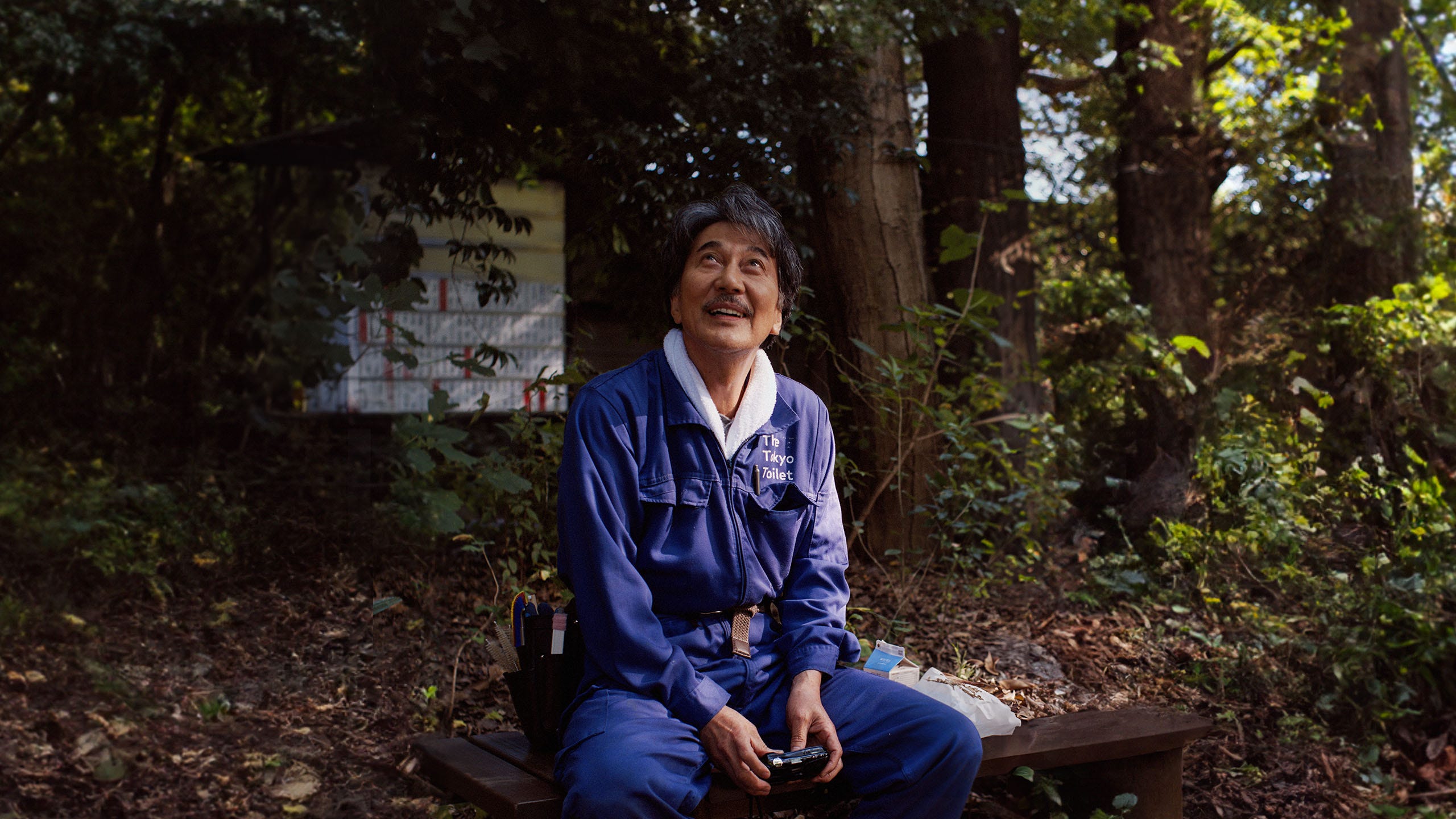
Perfect Days is a character case study film centering on a janitor who cleans restrooms in public parks throughout Tokyo. Appearing to be in his 50s or 60s, Hirayama goes about his days stoically. He rarely speaks, instead working quietly and observantly.
Hirayama embodies predictability. He gets a coffee from the same vending machine every morning, eats the same food for lunch, goes to the same places when he isn’t working. He reads in the evening. He nurtures the saplings of his favorite tree from his daily lunch spot. He cleans restrooms. He lives in solitude, though he isn’t lonely.
Already you can see his uniqueness. Why doesn’t this man embody the ideals we’ve been socialized to strive for our entire lives? Ideals like ambition, pursuit of novelty, and materialism? Where’s the risk, the excitement, the euphoria that only a fast life can bring?
We often hear about the benefits of the slow life but, arguably, don’t fully grasp its appeal. It sounds boring. We can do things that excite us and so we do.
There are many ideas to explore in the film, all centered around the theme of the slow life: ambition, materialism, and attention, to name a few.
Let’s get into it. Spoilers ahead…
Ambition (and Materialism)
How can you put so much into a job like this?
-Takashi (Hirayama’s young coworker, talking about custodial work)
A couple of things here: Hirayama takes pride in his work; Takashi assumes the work is not worthy of his pride.
The lack of respect for custodial jobs is not a foreign idea. Our world rewards entrepreneurship, business savvy, and ambition. Service jobs, while arguably more crucial to keeping society's cogs turning, do not fit that bill and thus are not rewarded. They don’t pay nearly as much as big business jobs. They are also much more frustrating, in my experience. Being essential doesn’t matter in a world with these values.
When I worked as a dishwasher in a dining hall at my university, the lack of care by the people I served constantly shocked me. The rules were simple and clearly posted: Dishes were to be put on a conveyor belt, while silverware went in bins next to the belt.
It shouldn’t shock you to hear that at least a third of dishes I received had silverware on them. This is frustrating because of the principle of the thing, yes, but also because it’s fast-paced work where silverware can easily get lost in the food waste trough. If diners had simply followed the posted directions, life would have been much easier for us dishwashers.
Hirayama’s job is much the same, where easily preventable things like litter next to the trash and other messes make his life harder. But instead of getting frustrated, Hirayama goes about picking up after folks without seeming to mind.
There’s a lesson right there: Thoughtless people are bound to exist. Why get frustrated when their existence is just a reality of the job and of life?
Okay, so the lack of respect or care from customers doesn’t have to make the job miserable. That doesn’t make the pay better. It doesn’t make the work any more glamorous. Why does Hirayama take so much pride in it?
Let’s flip that question on its head. Why shouldn’t he take pride in his work? There are several reasons why Hirayama, rather than his young coworker, is correct.
We agree service jobs are essential. Cleaning toilets in public spaces is a service job, therefore it is essential.
The pay isn’t great, no, but Hirayama has all he needs. It’s a living wage. Shouldn’t that be enough? He can’t get the nice new phone or the shiny car but those don’t improve life anyway (the Hedonic Treadmill tells you all you need to know about the folly that is materialism1).
Given the service aspect of the job, Hirayama has a direct impact on people’s experiences in public spaces. We all know how gross a lot of bathrooms in public parks are; a clean bathroom is a special thing.
How can Hirayama put so much into a job like this? The answer is clear now. He doesn’t need prestige or extravagant wealth. He needs to afford expenses to a point of contentment, to serve his community, and improve the lives of others in doing so.
Our cultural value of ambition doesn’t have to be so valuable.
What about the pursuit of novelty and the war for our attention?
Where our Attentions Ought to Lie
I’m sure you’ve heard the phrase before (“war for attention”). Big tech companies need your attention on their platforms to make money. The main way to monetize an online platform in this age is to sell ad space. If you don’t see any ads, they don’t make money. Thus, the more attention you give to these platforms, the more they profit.
This incentivized piece of advertising has been around longer than social media; the same incentives existed for television, and radio before that (even newspapers and billboards to some extent).
I’d argue the strength of incentive sharply grew when the attention-seeker landed in our pockets.
Today, teams of engineers and data scientists work to make their platform the most enticing for consumers. They make the platforms addictive. Do you remember when infinite scrolling didn’t exist yet?
Social media used to load a certain number of posts, then you had to actively choose to load more once you got to the bottom. That’s a natural breaking point. There is no natural breaking point with infinite scrolling (and this is just one example of manipulation for attention out of many).
Hirayama’s choice to use a flip phone, not have a TV in his home, and stick to reading books is a rare one. It’s rebellious, even. How dare he not update the world when he does something cool, so everyone can see it (sandwiched between two advertisements)?
Let’s explore the implications of this.
Depression and Reward-Center Hacking
Remember those engineers I mentioned a couple paragraphs ago?
No, you say?
Your short term memory is fried because of all the doomscrolling you’ve been doing, you say?
Oops. That’s not great. But hey, I can’t remember either. Cheers.
As a reminder, there are teams of engineers working with the sole goal of keeping you on their platform for as long as possible.
We already discussed one example of this: Infinite scrolling. An evolution, and symptom, of it is clickbait articles. Then there’s optimized color schemes; reactions; comment sections filled with rage-baiting bots; an algorithm that learns your interests (and what makes you angry), then feeds you content based on all of it.
Our brains were not meant to move from one thought to the next in such quick succession. Rage then rage then LOL then rage again, all in the span of a minute, has got to be doing some damage in the ol’ noggin.
It hacks the reward centers in our brains, motivating us to continue onward endlessly. Once we’ve had our fill, our brains feel weird. Coming back to the real world can be disorienting.
All that motivation-boosting for our thumbs to keep scrolling has drained our reserves, leaving us, well, unmotivated.
Not great for anyone. Terrible for people suffering from depression. We’ve talked about how depression can make it hard to do simple daily tasks. This only compounds when you add a new lack of motivation to the mix.
I think we can learn something from Hirayama, here. He offers an alternative to the spikes and crashes and endless muck.
The secret of happiness, you see, is not found in seeking more, but in developing the capacity to enjoy less.
-Socrates
What Socrates says, and Hirayama embodies, can greatly improve our wellbeing. Put yourself in Hirayama’s shoes, for a second.
Reading. Working in the park. Caring for saplings. Enjoying meals in public spaces. Living life slowly, appreciating the small things.
These things don’t attack our reward systems. They don’t demand attention at all hours, then leave us feeling drained and needing more. They’re quiet, fulfilling, and life-giving.
Where big, artificial highs lead to big, legitimate lows, small pleasures only add to our experience.
We people who suffer from depression need those additions. We don’t need to be pushed any lower than we are. It gets risky.
Perfect Days brilliantly portrays the contrast here through Hirayama and Takashi. Takashi’s mood is like a sine wave, swinging wildly up and down as he stares at his phone while working, recklessly pursues a girl and tries for quick money.
Hirayama’s, as we’ve discussed, is much more stable.
In Conclusion
Stability is desirable to me as a depresso. I lose many battles against those pesky engineers but I am working on it every day.
This film shifted my perspective on the value of small pleasures, and the slow life.
The slow life is valuable. The slow life is beautiful.
The slow life is not, however, easy. It’s hard to beat the engineers by not giving them attention. It’s hard not to chase material prestige (we all want to impress others, right?). It’s hard to be different.
Social media and other things trying to get you to move quicker aren’t capital B Bad. As with everything else, moderation is the key. You have to find a balance.
And speaking of balance, your mission this week is actually two missions (mwahaha).
First: Be mindful of your scrolling. You don’t have to change your habits drastically. You don’t have to change them at all. Try, however, to take note of how your mind and body feel after a long scrolling session.
Second: Note some small pleasures you generally take for granted as they come this week. Your first sip of coffee in the morning, a ray of sunshine hitting your face, a hot shower. Something else, too.
Let us know how these go.
Thank you for being here.
I love you.
-Ethan
Did Perfect Days shift your perspective? Tell us how in the comments!
This page is not intended to be medical advice. Consult with a psychiatrist or other provider before pursuing any treatment options discussed here.
If you are in crisis, call or text the National Suicide Hotline: 988
The hedonic treadmill is the idea that an individual's level of happiness, after rising or falling in response to positive or negative life events, ultimately tends to move back toward where it was prior to these experiences.
I see this as psychological evidence disputing the allure of greed. A nice, new thing might temporarily increase happiness, but the happiness will soon return to baseline. So if you have what you need, why reach for more? It’s a nice thought, though, I admit, a hard one to live out.
Ethan - this is great. Hope you are well - there is a lot to be said about and admired in a contemplative life. Jud
Wow !! So SO true ! Ty Ethy 😘